
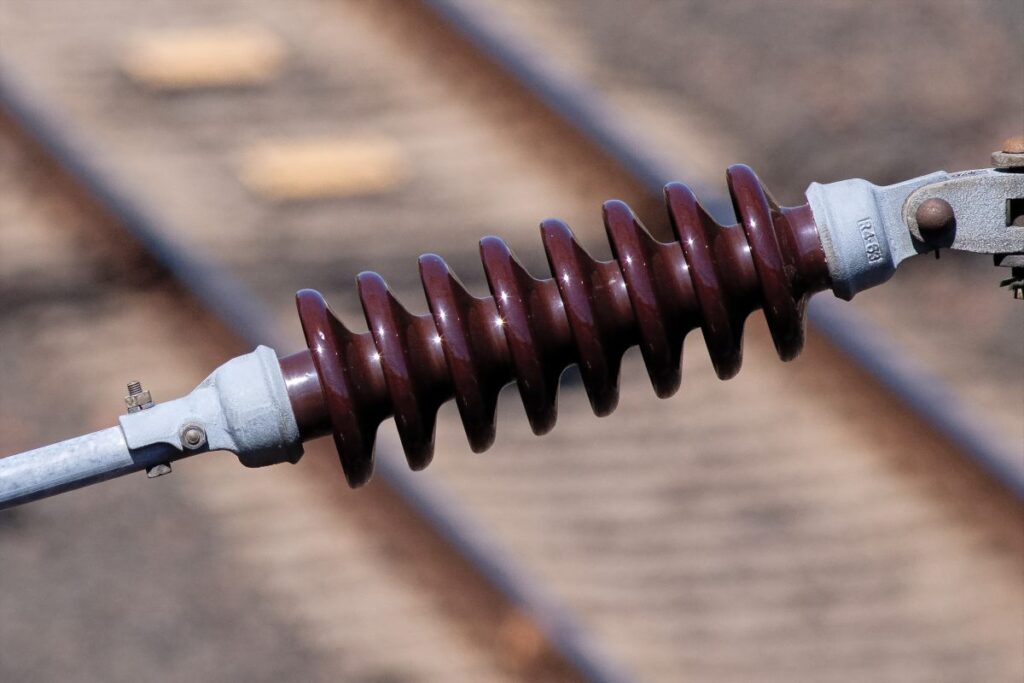
What is an electrical insulator and what is it used for?
Definition of an electrical insulator
An electrical insulator is a component designed to separate and support conductive elements (such as busbars, cables, or high-voltage equipment), preventing electrical current from flowing unintentionally between them or to ground. Its main purpose is to ensure electrical safety and service continuity in grids and installations.
Unlike other elements in the system, an insulator is not meant to carry current, but quite the opposite: to block the passage of electrical current under normal operating conditions and, as we explain in our article how electrical overloads affect insulator performance, withstand the overvoltages that occur during switching operations or faults. At the same time, it must provide the mechanical strength required to withstand wind loads, conductor weight, short-circuit forces and vibrations, which can affect insulator durability.
In short:
- Electrical function: prevent current from flowing outside the intended paths.
- Mechanical function: support conductors and equipment while maintaining safety clearances.
- Safety function: protect people, equipment, and infrastructure. In this regard, it is worth considering: what problems can arise if an insulator does not meet safety regulations.
Operating principles and role in electrical systems
An insulator works thanks to the dielectric properties of the material it is made from (porcelain, glass, polymers, composites, etc.). These materials present a very high resistance to current flow, even when subjected to high potential differences, as long as design limits are not exceeded.
When installed between an energized conductor and a reference point (another phase, a metallic structure, or ground), the insulator:
- Withstands the applied voltage without internal puncture (preventing internal flashover/puncture).
- Controls the electric field around the conductor, avoiding discharges through air or across its own surface.
- Maintains the insulation distance (air clearance and surface path) needed to prevent surface discharges or electric arcs.
Within an electrical system, insulators are present in many critical points:
- In transmission and distribution networks, supporting conductors on towers and poles.
- In electrical substations, insulating busbars, disconnectors, transformers, and other equipment—an area we cover here: what types of insulators are commonly used in substations.
- In industrial facilities and renewable-energy installations, ensuring the correct separation between live parts and metal structures.
A failure in an insulator is not just a local issue: it can trigger power outages, damage to critical equipment, and serious safety risks.
Basic parameters that define a good insulator
Although each project has its specifics, any company selecting or evaluating electrical insulators should pay attention, at minimum, to these key parameters:
| Parameter | What it indicates | Why it matters |
|---|---|---|
| Rated and maximum service voltage | The voltage level the insulator is designed for. | Must match the system voltage and required safety margins. |
| Impulse withstand level | Ability to withstand switching and lightning impulses (surge voltages). | Key to preventing punctures and discharges during transient events. |
| Creepage distance | Surface path length between parts at different potentials. | Essential in polluted or humid environments; governed by standards and specifications. |
| Mechanical strength | Breaking load, tensile, bending, or compressive strength, depending on insulator type. | Determines ability to withstand conductor weight, wind, and dynamic loads. |
| Pollution performance | Response to dust, salinity, industrial pollution, ice, etc. | Impacts maintenance frequency and risk of surface discharges. |
| Ageing resistance | Stability of properties over time (UV, thermal cycles, erosion). | Directly affects service life and total cost of ownership (TCO). |
These factors are complemented by compliance with international standards, manufacturing quality, and the manufacturer’s experience. For industrial and infrastructure projects, working with a specialist supplier such as POINSA simplifies selecting the right insulator type and reduces the risk of oversizing—or, worse, underspecifying the real demands of the system.
Types of electrical insulators
Classification by material
Electrical insulators can first be classified by the material they are made from. In our dedicated content “what types of insulators exist and what are they used for” we go deeper into this classification and the most common applications for each family.
Each material provides a different balance between dielectric and mechanical properties, weather resistance, and cost, which determines suitability for each application.
Main materials used in electrical insulators:
- Porcelain
- Toughened glass
- Polymeric and composite materials
Porcelain insulators
Porcelain insulators are one of the most traditional and widely used solutions in medium- and high-voltage networks. They are manufactured from high-quality ceramic materials, vitrified and glazed to ensure good mechanical strength and a smooth, low-porosity surface.
- Advantages:
- Very good mechanical and thermal stability.
- A well-known and proven behavior over decades of use, enabling informed comparisons, as discussed in “how to compare the durability of ceramic and polymer insulators”.
- Adequate resistance to UV radiation and weathering.
- Limitations:
- Heavier than other alternatives (impact on structures and handling).
- More fragile against mechanical impacts (during transport or installation).
- Potential surface performance degradation in heavily polluted environments if creepage distance is not correctly designed.
When a traditional and robust solution is required, POINSA supplies ceramic insulators optimized for transformers, substations, and medium- and high-voltage networks, tailored to different standards and operating conditions.
Toughened glass insulators
Toughened glass is mainly used in suspension insulators for overhead lines. Its transparent finish makes internal damage easier to detect, since glass tends to shatter when it fails.
- Advantages:
- Excellent surface finish, helping performance under pollution.
- Good dielectric performance and weather resistance.
- Defects are easier to identify thanks to transparency.
- Limitations:
- Fragile against localized impacts.
- Less design flexibility than composite materials.
Polymeric and composite insulators
Polymeric or composite insulators (typically based on silicone, resins, and fiberglass reinforcement) have gained adoption due to their low weight, good pollution performance, and design flexibility. Many projects compare them as explained in “what advantages polymer insulators have over ceramic ones”.
In this field, POINSA develops and manufactures polymeric insulators for lines, substations, and special applications, combining lightness, strong dielectric properties, and durability in demanding environments.
| Characteristic | Composite insulators |
|---|---|
| Weight | Significantly lighter, easing installation and reducing structural loads. |
| Pollution performance | Hydrophobic surfaces reduce leakage currents in harsh environments. |
| Design flexibility | Allows optimized geometries to increase creepage distance. |
| Ageing | Highly dependent on material formulation and manufacturing process. |
Where weight, pollution resistance, and installation ease are critical variables, composite insulators offer a highly attractive alternative—provided that products are selected from experienced manufacturers with strong quality control, such as POINSA.
Classification by voltage level
Another way to segment electrical insulators is by the installation’s voltage level. Insulators are not designed the same way for low voltage as for extra-high voltage lines or transmission substations.
- Low-voltage insulators (up to ~1 kV)
- Used in industrial, commercial, and residential installations.
- Smaller dimensions and moderate mechanical requirements.
- Often integrated into enclosures, panels, or compact equipment.
- Medium-voltage insulators (~1 kV–36 kV, depending on local standards)
- Common in distribution networks, substations, and MV switchgear.
- Require a proper balance between dielectric strength, creepage distance, and size.
- Typically designed under specific international distribution standards.
- High- and extra-high-voltage insulators
- For transmission networks and high-power substations.
- Require high creepage distances, lightning impulse withstand, and significant mechanical capability.
- Often implemented as insulator strings or large post/bushing insulators.
In high-power applications, it is also common to analyze what advantages ceramic insulators have over polymer ones in transformers, since the environment and equipment design strongly influence the choice of insulation technology.
Common designs: suspension, post, bushings, and others
Beyond material and voltage, it is essential to understand construction types, as each design serves a specific function within installations and networks.
Suspension insulators
Suspension insulators are mainly used on overhead medium- and high-voltage lines. They are arranged in strings that support the conductor below, helping accommodate tensile loads and movements caused by wind and thermal expansion.
- Made up of discs or modules connected together.
- String length is adjusted to voltage level and required creepage distance.
- Can be made from toughened glass, porcelain, or composite materials.
Post insulators
Post insulators are used to support busbars, conductors, or equipment in an elevated position while keeping them insulated from metal structures or ground. They are common in substations and distribution panels. In these environments, POINSA supplies indoor and outdoor post insulators adapted to different voltage levels and mechanical loads.
- Withstand compressive and bending stresses.
- Designed in different heights and geometries (cylindrical, ribbed, etc.).
- It is critical to verify their mechanical capability and short-circuit performance.
Bushing insulators
Bushings allow a conductor to pass through a wall, enclosure, or metal barrier while maintaining the proper insulation between the live part and the structure. They are common in power transformers, bus ducts, and high-voltage panels. In this line, POINSA designs transformer bushings and feed-through insulators that meet different voltage levels and test requirements.
- Designed to withstand high voltage between the conductor and enclosure.
- Include profiles and materials that control the electric field.
- Correct sizing is key to the reliability of the associated equipment.
Other insulator types
There are also specific solutions tailored to particular sectors or conditions:
- Railway insulators, designed for catenary and power supply systems. The interaction with traction systems is discussed in “what role insulators have played in railway electrification projects”. For these applications, POINSA manufactures railway insulators approved for different networks.
- Special insulators for explosive or corrosive atmospheres, with specific materials and finishes.
- Custom insulators for power equipment, test systems, or unique applications, available through POINSA’s range of custom insulators and made-to-measure products.
Choosing the right insulator type is as important as selecting the material or voltage class. The same material can behave very differently in an overhead line, a substation, or a closed industrial environment.
Specialist manufacturers such as POINSA work with a broad range of suspension, post, bushing, and custom solutions, enabling designs to be adapted to project needs and installation environments.
Key technical properties of electrical insulators
Dielectric strength and behavior under overvoltages
Dielectric strength is the fundamental property of an electrical insulator: it expresses the maximum voltage the material can withstand without puncture or disruptive discharge. In practice, not only the material matters, but also the insulator geometry and external conditions (pressure, humidity, pollution, etc.).
In real service, insulators are not exposed only to constant voltage: they face nominal operating voltage, temporary overvoltages, and switching or lightning impulses. To better understand these operating phenomena, you may find it useful to review how variable electrical loads affect insulator performance.
- Nominal operating voltage: the voltage the installation is designed for.
- Temporary overvoltages: associated with unbalances, switching, or earth faults.
- Transient overvoltages: impulses caused by switching operations or atmospheric discharges (lightning).
To that end, parameters are defined such as:
- Lightning impulse withstand voltage.
- Switching impulse withstand voltage.
- Power-frequency withstand voltage (50/60 Hz), in dry and wet conditions.
In critical projects (substations, high-voltage lines, strategic industrial plants), working with manufacturers such as POINSA helps align these levels with international standards and the specific service conditions of each system.
Mechanical strength and stresses the insulator is subjected to
Besides their electrical function, electrical insulators withstand considerable mechanical stresses: tension in suspension strings, compression in post insulators, bending due to wind or short-circuits, etc. For applications where extreme stresses dominate, it is especially relevant to analyze which insulators offer greater resistance to mechanical and electrical impacts, where solutions are compared in high-stress environments.
The most common stresses include:
- Tension: especially relevant in overhead-line suspension strings.
- Compression: predominant in post insulators for busbars or equipment.
- Bending: in supports subjected to wind, vibrations, or short-circuits.
- Dynamic short-circuit stresses: intense electrodynamic forces over very short times.
| Insulator type | Main stress | Critical design aspects |
|---|---|---|
| Suspension | Tension | Ability to withstand breaking load and wind/ice loads. |
| Post | Compression / bending | Stability under permanent loads and short-circuit forces. |
| Bushing | Combined | Mechanical integrity in transformers, enclosures, and walls. |
Datasheets usually specify values such as:
- Mechanical breaking load (kN or kgf).
- Maximum allowable bending moment.
- Recommended working load with safety factors.
Correctly sizing the mechanical strength of the insulator helps prevent structural failures, conductor drops, and damage to supports—directly impacting safety and system availability.
Behavior under pollution, humidity, and extreme weather conditions
In reality, insulators do not operate in the lab, but in complex environments: coastal zones with salt fog, industrial areas with pollution, desert climates with dust, regions with ice and snow, etc. Therefore, pollution and weather performance is a critical property.
This depends on factors such as creepage distance, shed profile, and material choice. For projects in especially demanding environments, it is advisable to consider analyses such as which materials offer greater durability under extreme conditions, which help select the most suitable technology for the environment.
Pollution (salt, dust, conductive particles) deposits on the insulator surface. If this layer gets wet (light rain, fog, dew), it can cause:
- High leakage currents over the surface.
- Localized heating and material erosion.
- Partial discharges or surface arcs, known as flashovers.
International standards define minimum creepage distances depending on:
- System voltage level.
- Expected pollution level (light, medium, heavy, very heavy).
- Material type and shed profile.
Other environmental factors also matter:
- UV radiation and temperature: affect ageing of polymers and coatings.
- Freeze–thaw cycles: can affect materials through expansion and contraction.
- Wind and snow loads: influence mechanical stresses.
Other relevant properties in design and selection
Beyond the main properties, selecting electrical insulators for industrial and infrastructure projects should consider other factors that directly influence reliability and total cost of ownership.
- Thermal stability
- Ability of the material and design to operate across a wide temperature range.
- Resistance to thermal cycles without cracking or degradation.
- Ageing and service life
- Material behavior over the years under UV, pollution, and humidity.
- Retention of dielectric and mechanical properties within acceptable margins.
- Standards and test compliance
- Alignment with IEC, EN, IEEE, or other standards, depending on market and application.
- Ability to provide type, routine, and special tests supporting the design.
- Repairability and replacement
- Ease of replacing units in service.
- Dimensional compatibility with existing equipment and structures.
A proper insulator design balances these properties to achieve:
- Maximum reliability under real working conditions.
- Cost optimization (avoid oversizing without need, but prevent insufficient designs).
- Consistency with the maintenance strategy of the installation (preventive, predictive, corrective).
The experience of manufacturers such as POINSA is especially valuable at this stage, as it helps align technical specifications, standards, and real operating conditions to select the most appropriate insulator type and size it correctly.
International regulations and standards applicable
Main IEC, IEEE, EN standards and other references
The selection and design of electrical insulators are not based only on internal engineering criteria. To ensure safety, compatibility, and quality in international projects, it is essential to comply with recognized technical standards in the electrical sector.
Among the most relevant bodies are:
- IEC (International Electrotechnical Commission): global reference for the design, testing, and classification of medium- and high-voltage equipment, including insulators.
- IEEE (Institute of Electrical and Electronics Engineers): very influential in markets such as the USA, with specific standards for power networks and related equipment.
- EN / CENELEC: European standards that, in many cases, harmonize and adopt IEC standards for the European market.
- National standards: adaptations or specific developments (e.g., country-specific requirements for transmission and distribution networks).
Key idea: Working with insulators that comply with applicable IEC/EN/IEEE standards supports project approval, simplifies technical audits, and builds trust for asset owners, engineering firms, and regulators.If you read “which international standards ensure the quality of insulators” you will find the main IEC, EN, IEEE and local references in detail, and how they affect both design and testing of insulators used in power networks.
Type tests, routine tests, and special tests
Standards do not only define dimensions and insulation levels; they also set which tests insulators must pass before being supplied and installed. These tests are normally classified as:
- Type tests
- Performed on a limited number of representative units of a design.
- Validate the electrical and mechanical design against extreme values of voltage, load, temperature, etc.
- Include, for example, lightning impulse withstand tests, power-frequency withstand tests, mechanical load-to-failure tests, accelerated ageing, etc.
- Routine tests
- Performed on each produced unit or on a very high percentage of production.
- Verify that each supplied insulator meets the minimum quality and safety criteria defined by the design.
- Include visual checks, dimensional checks, basic dielectric tests, and basic mechanical checks, among others.
- Special tests
- Designed for projects or conditions that go beyond baseline standards.
- For example, salt-fog chamber tests, extreme thermal cycles, very severe pollution simulation, or customer-specific test programs.
- Common in critical projects (international interconnections, strategic plants, highly corrosive environments).
| Test type | Purpose | When it is performed |
|---|---|---|
| Type | Validate the design and performance of the model. | During product development / qualification. |
| Routine | Verify the quality of each produced unit. | During manufacturing, before shipment. |
| Special | Demonstrate behavior under specific conditions. | Upon customer request or for unique projects. |
In addition to general standards, it is worth considering market-specific certification requirements, as explained here: “which certifications insulators need to enter international markets”.
In projects where local specifications evolve quickly, it is crucial to understand “how to adapt insulators to new regulations in international markets”, especially when the same design must serve different countries or utilities with their own requirements.
Manufacturers such as POINSA can provide the test documentation (lab reports, certificates, test protocols) that many engineering firms and utilities require as part of the approval process.
Certifications, quality, and requirements for international projects
In international projects, it is not enough to comply with a single standard. It is often necessary to demonstrate a robust quality management system, manufacturing traceability, and a track record in comparable installations.
Some aspects companies typically review when selecting a supplier of electrical insulators include:
- Certified management systems
- Quality certifications (e.g., ISO 9001) supporting process consistency.
- In some cases, environmental or occupational safety certifications that boost global confidence in the manufacturer.
- Material and process traceability
- Ability to identify manufacturing batches, materials used, and tests performed.
- Clear documentation to resolve incidents and root-cause analyses if needed.
- Approvals and vendor lists
- Inclusion on approved vendor lists of utilities, grid operators, or major industrial groups.
- Previous experience in similar projects (voltage, environment, country) that provides additional assurance.
- Multi-region standards compatibility
- Ability to supply products that meet IEC/EN and local requirements simultaneously.
- Flexibility to adapt designs to each customer or market’s specifications.
In summary, international standards are the foundation of insulator reliability. Integrating them from the specification and material selection stage helps:
- Reduce technical and safety risks.
- Simplify project approval by regulators and end clients.
- Ensure interoperability among equipment from different manufacturers.
POINSA, as a manufacturer of electrical insulators, can support companies and engineering firms in the interpretation and practical application of these standards, helping define realistic specifications aligned with international market demands.
Criteria for choosing electrical insulators in industrial projects
Voltage level, power, and installation configuration
The first criterion for correctly selecting electrical insulators in any industrial project is to accurately understand the installation’s electrical architecture: voltage levels, short-circuit power, connection schemes, and clearances between equipment. Any mistake at this stage can lead to costly oversizing or, worse, underspecification that compromises safety.
- System voltage level
- Determines the insulator’s withstand voltages (power frequency, switching impulses, lightning impulses).
- Affects insulator height and length, as well as required creepage distance.
- Short-circuit power
- The higher the available short-circuit power, the greater the electrodynamic forces in case of a fault.
- It is critical to verify that the insulator’s mechanical strength can withstand these events.
- Installation configuration
- Overhead lines, GIS/AIS substations, transformer stations, distribution panels, etc.
- Each configuration implies different insulator types: suspension, post, bushings, indoor insulators, etc.
Beyond electrical factors, it is important to analyze the network configuration (overhead lines, substations, transformer stations, distribution panels…) and the environment (indoor, outdoor, industrial, urban). This approach is developed in more detail in “how to choose an insulator for indoor and outdoor electrical networks”, which covers practical selection criteria based on installation location.